
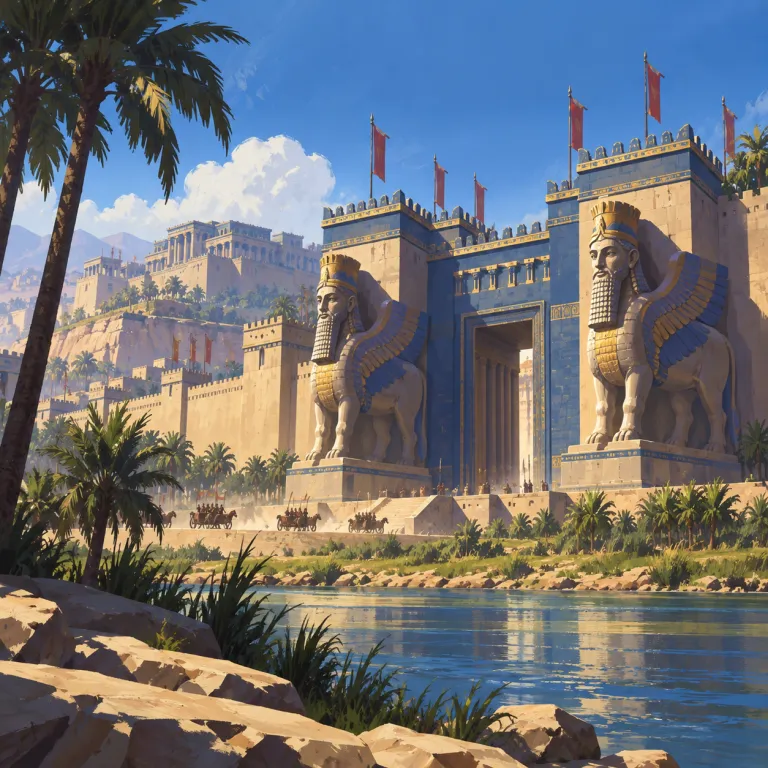
Assyria
A powerful ancient empire, often in conflict with Israel.
The place
Assyria, also known as Asshur, was a powerful ancient empire centered in Mesopotamia, in what is now modern-day Iraq. The Assyrians are mentioned extensively throughout the Old Testament, often in the context of their military conquests and their interactions with the kingdoms of Israel and Judah.
The name "Asshur" first appears in Genesis 10:11, where it is associated with Nimrod, who is said to have built several cities, including Nineveh, the capital of Assyria. In Genesis 25:18, the descendants of Ishmael are described as living in the region from Havilah to Shur, near the border of Egypt, as one goes toward Assyria.
Assyria began to emerge as a significant power in the 9th century BC, and its kings are mentioned in the books of Kings and Chronicles. The Assyrian king Shalmaneser III is recorded as receiving tribute from Jehu, king of Israel (2 Kings 15:19-20). Later, Tiglath-Pileser III, also known as Pul, conquered parts of Israel and deported some of its inhabitants (2 Kings 15:29; 1 Chronicles 5:6, 26).
The Assyrian Empire reached its zenith during the reign of Sennacherib, who is known for his military campaigns against Judah and his siege of Jerusalem during the reign of King Hezekiah (2 Kings 18-19; 2 Chronicles 32; Isaiah 36-37). The prophet Isaiah played a significant role in encouraging Hezekiah to trust in God and resist the Assyrian threat.
Other Assyrian kings, such as Esarhaddon and Ashurbanipal, are also mentioned in the Bible (Ezra 4:2; 2 Chronicles 33:11). The fall of the Assyrian Empire is alluded to in the prophetic books, particularly in Nahum, which foretells the destruction of Nineveh (Nahum 3:18-19).
Where this place lies
Relations
Founder or origin
 Asshur@Gen.10.11
Where the Bible names it
56 chapters, 136 verses