Night Trial before Sanhedrin
- Dates
- 31 AD
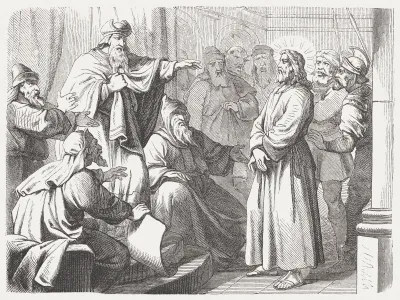
In a night trial before the Sanhedrin (the council of Jewish leaders), Jesus stands before Caiaphas and is questioned. False witnesses are brought in to testify against Jesus. After demanding that Jesus speak, the high priest condemns Christ.

In detail
Jesus was seized around midnight. His trial consisted of two phases, the first being the ecclesiastical trial before the Jewish religious authorities, and the second the civil trial before Pilate and Herod. He was given two preliminary hearings, one before Annas alone and another before Annas and Caiaphas and was arraigned twice before the Sanhedrin, first by night and then by day. He appeared twice before Pilate and once before Herod, between the two appearances before Pilate.
In this first night trial Christ was brought before Caiaphas. The Sanhedrin was composed of members from these two groups, and from the priests. All three are listed in the parallel passage in Mark (ch. 14:53). They assembled for this night trial of Jesus, at approximately 3 A.M. Members of the Sanhedrin who were friendly toward Jesus, or at least interested in giving Him a fair hearing, were deliberately not invited (see on v. 66).
This "council" was the Great Sanhedrin, which normally consisted of 71 members, and which was, at this time, the highest executive, legislative, and judicial body. For two years the Sanhedrin had spies following Jesus, in order that all He said and did might be reported. But these spies had not returned with any information useful to the leaders' evil purposes. They determined to put Him to death. But they had no case against Jesus, much as they might dislike Him, and in their haste had not had time to manufacture one. They hoped to discredit Jesus in the eyes of His fellow countrymen by proving the charge of blasphemy, and to incriminate Him before the Romans on the charge of sedition. They were unable to find even false witnesses whose tales could be made to agree. Finally, two witnesses came forward, but even these last two actually disagreed (Mark 14:59) on essential points, and their testimony was vague and contradictory. Nevertheless, the high priest pretended to accept their testimony (Matt. 26:62), although he knew well that Jesus could not be sentenced on the basis of it.
Caiaphas demanded that Jesus reply under oath to the question now put to Him. In spite of the testimony of all the false witnesses, the Sanhedrin still had no case against Jesus. Caiaphas hoped to make Jesus incriminate Himself. This, too, was illegal. A man could not be condemned on His own testimony. Caiaphas pretended to arraign Christ before the bar of God. Jesus had avoided making the direct claim to being the Messiah, or Christ, perhaps in part because in popular fancy Messiah was to lead the Jews in an armed revolt against Rome. Jesus forbade His disciples to make the claim for Him (ch. 16:20). This was not the first time the question had been put to Jesus (see John 10:24). When placed under oath Jesus did not refuse to testify in fact, that is precisely when He did testify.
Caiphas then tore his clothes. This is, as a sign of being overcome with righteous indignation at Jesus' alleged blasphemy (see v. 64). The Mosaic law prohibited the high priest from tearing his garments (Lev. 10:6 21:10), the reason being that his garments represented the perfect character of Jesus Christ. Caiaphas thus stood condemned before the very law he posed as defending, and disqualified himself from serving as high priest. However, rabbinical regulations permitted one hearing blasphemy to rend his garments. But Jesus had not blasphemed, either in reality or according to the accepted rabbinical definition (see on Matt. 26:65). This was an illegal vote, for it was taken at night. Even though voted, the verdict did not have standing in law unless and until it was ratified by the Romans.
Bible passages
- Matthew 26:57-75
57 And they that had laid hold on Jesus led him away to Caiaphas the high priest, where the scribes and the elders were assembled. 58 But Peter followed him afar off unto the high priest’s palace, and went in, and sat with the servants, to see the end. 59 Now the chief priests, and elders, and all the council, sought false witness against Jesus, to put him to death; …
- Mark 14:53-72
53 And they led Jesus away to the high priest: and with him were assembled all the chief priests and the elders and the scribes. 54 And Peter followed him afar off, even into the palace of the high priest: and he sat with the servants, and warmed himself at the fire. 55 And the chief priests and all the council sought for witness against Jesus to put him to death; and found none. …
- Luke 22:54-65
54 Then took they him, and led him, and brought him into the high priest’s house. And Peter followed afar off. 55 And when they had kindled a fire in the midst of the hall, and were set down together, Peter sat down among them. 56 But a certain maid beheld him as he sat by the fire, and earnestly looked upon him, and said, This man was also with him. …
- John 18:25-27
25 And Simon Peter stood and warmed himself. They said therefore unto him, Art not thou also one of his disciples? He denied it, and said, I am not. 26 One of the servants of the high priest, being his kinsman whose ear Peter cut off, saith, Did not I see thee in the garden with him? 27 Peter then denied again: and immediately the cock crew.
Text of the King James Version.
Images