
Joseph Taken to Egypt
- Dates
- 1683 BC
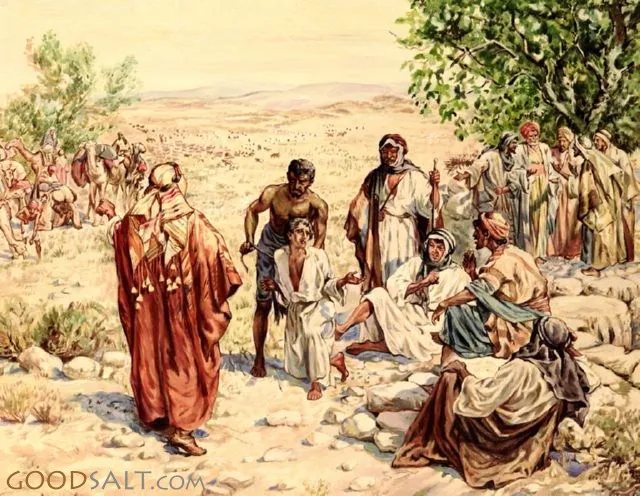
Joseph goes to check on his brothers who are tending their father's sheep. They see him coming and plot to kill him. Reuben intercedes and Joseph is cast into a pit and sold as a slave to Midianite traders. Jacob is told wild animals killed Joseph.
In detail
Jacob was apparently unaware of how keenly his sons hated Joseph, a fact they had been at pains to hide from him. This is evident not only from the fact that he sent Joseph alone to visit them but also from his reaction to their story of this disappearance. He seems never for a moment to have suspected foul play on their part. Jacob's concern for his sons was probably due not alone to their long absence but also to fear that fellow countrymen of the Shechemites may have either taken revenge for the massacre or hindered them in the pasturing of their flocks.
When Joseph's brothers saw him coming, they plotted to kill him. To men who had slain the males of a whole city, the murder of a single individual could hardly seem a grievous sin. Hatred had developed in their hearts to the point that they were ready to kill their own brother in cold blood. They were far from home and its restraining influences. The "pit" into which they intended to cast his body was one of the cisterns common in Palestine. The story they proposed to tell their father would be entirely credible, for Palestine was a wild country during the second millennium b.c., and lions, bears, and other animals roamed at will (see Judges 14:5 1 Sam. 17:34).
Though Reuben had been far from perfect himself (see ch. 35:22), his heart was not so hard as theirs. As the eldest son, he felt a special responsibility for his younger brother, and determined, if possible, to save him from them. The would—be murderers were content, for the moment, to follow Reuben's suggestion. Weak and vacillating though he was (ch. 49:4), Reuben appears to have been the only one of Joseph's brothers in whom the natural affection of a brother was not completely lost.
Though he lacked the courage to resist openly their stronger wills, he at least made a timid attempt to save Joseph's life. Reuben's plan was commendable as far as it went, but it failed because of his lack of determination and vigilance. Adding insult to injury, they stripped Joseph and threw him into a dry cistern nearby. It seems that cistern were often put to such a use (see Jer. 38:6). The thought that he would die a painful death by starvation apparently satisfied their vindictiveness, and they paid no heed to his piteous appeals (ch. 42:21, 22).
Judah saw in the appearance of the Ishmaelite caravan a means for permanently disposing of Joseph without taking his life. This would effectively eliminate him from further competition in the contest for the birthright. The brothers reasoned, no doubt, that Joseph had done little to increase the family fortune, and they saw no reason why he should fall heir to the wealth their hands had produced. Judah's proposal proved to be a most welcome one to all the brothers, who by now, after reflecting upon their original impulse to kill Joseph, found themselves somewhat reluctant to lay their own hands upon him.
The selling of Joseph was an overt violation of the principle that no man has the right to subject another to involuntary servitude (cf. Lev. 25:39—43). It demonstrates clearly the extent of moral perversion that had taken place in the hearts of Joseph's brothers. Those who sold Joseph demonstrated thereby that they had utterly lost all natural affection. Joseph's sale into slavery is the first recorded example in the Bible of such a transaction.
Though Reuben was beside himself with grief and perplexity, his ruthless and unrelenting brothers were at no loss for a plan. Apparently, however, they had neither the brazen boldness to carry through their scheme in person nor the courage to witness their father's first outburst of grief. Hence they arranged for another, probably a slave, who knew nothing more of the matter than what he was told, and so could not reveal their dark secret, to carry the bloody coat to Jacob in Hebron. Convinced of Joseph's death by the undeniable evidence presented, Jacob entered upon a period of mourning, according to the custom of ancient times.
Bible passages
- Genesis 37:12-36
12 And his brethren went to feed their father’s flock in Shechem. 13 And Israel said unto Joseph, Do not thy brethren feed the flock in Shechem? come, and I will send thee unto them. And he said to him, Here am I. 14 And he said to him, Go, I pray thee, see whether it be well with thy brethren, and well with the flocks; and bring me word again. So he sent him out of the vale of Hebron, and he came to Shechem. …
Text of the King James Version.
Images
