
Ishmael Conceived
- Dates
- 1861 BC
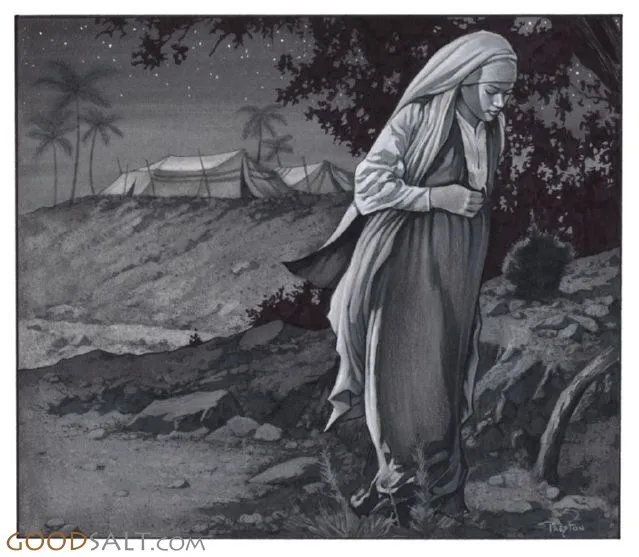
Sarai bore no children, so she suggests Abram take her handmaid, Hagar, as a wife, customary in those times, to bear an heir. Abram agrees and Hagar bears him a son whom he names Ishmael. The act shows a lack of faith in God's promise. He is 85.
In detail
An handmaid. Notwithstanding all the promises of God, the fact remained that Abram was still without a child ten years after the first promise had been made to him (v. 3). Hagar, an Egyptian servant of Sarai, is introduced. Since the Egyptians were a powerful nation in Abram's time, it is most singular to find an Egyptian servant in a Palestinian household. Hagar was probably the personal attendant given to Sarai when she was taken to Pharaoh (see ch. 12:15, 16). That she was still in Abram's house tends to show that Pharaoh had not taken back the gifts he had given Abram.
Hagar. This is not an Egyptian name. Her original name is not given. The name Hagar, meaning "flight" in Arabic, may have been given to her after her flight from her mistress.
Go in unto my maid. Faithlessly concluding that there was no hope of her bearing children, Sarai decided to follow the practice of her native country in order to provide an heir for the family. The legal codes of Mesopotamia recognized the practice whereby a childless wife might give one of her slaves to her husband and obtain children by means of her, and determined precisely the rights of such offspring. Regulations were needed particularly in the case of a first wife who would bear children after the servant had done so, or when a servant would become overbearing after being honored by giving birth to an heir (see the code of Hammurabi, sections 144—146, 170, 171).
Abram hearkened. Faith may be genuine and yet prove to be weak in moments of stress and perplexity. A vigorous faith will cling to the promise, and to that alone, trusting entirely to God for its accomplishment. Such was Abram's faith, except upon three or four brief occasions, throughout a long and eventful life. God had no need of Abram's devices for the accomplishment of His promise.
Trust and obedience alone were required. In complying with Sarai's rash suggestion, Abram followed in the footsteps of Adam. In both instances the result was suffering and disappointment, and the imagined blessing proved to be a curse. By listening to Sarai's suggestion Abram created for himself difficulties far reaching in their consequences. There ensued domestic trouble and heartache, and hatred between the future offspring of both wives. Again, in the present day, how bitterly the modern representatives of Sarai's and Hagar's descendants, the Jews and the Arabs, have contended for the possession of the Holy Land!
Bible passages
- Genesis 16:1-16
1 Now Sarai Abram’s wife bare him no children: and she had an handmaid, an Egyptian, whose name was Hagar. 2 And Sarai said unto Abram, Behold now, the Lord hath restrained me from bearing: I pray thee, go in unto my maid; it may be that I may obtain children by her. And Abram hearkened to the voice of Sarai. 3 And Sarai Abram’s wife took Hagar her maid the Egyptian, after Abram had dwelt ten years in the land of Canaan, and gave her to her husband Abram to be his wife. …
Text of the King James Version.
Images

