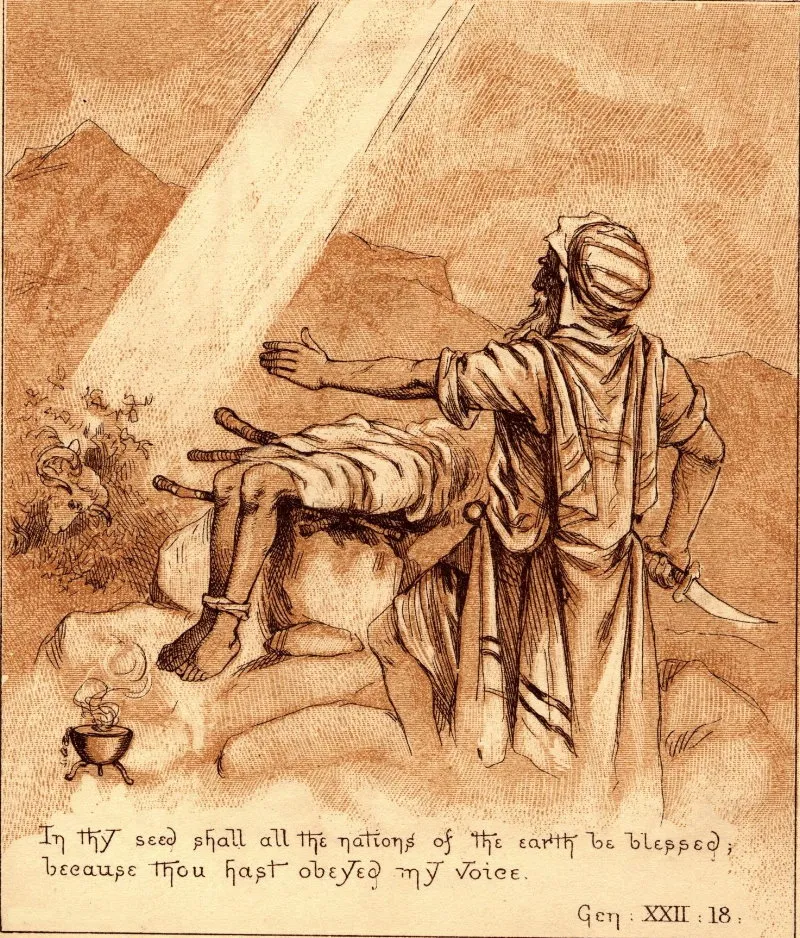
Abraham's Call to Sacrifice Isaac
- Dates
- 1831 BC
God tests Abraham's faith by calling him to offer his son as a sacrifice. "God will provide" expresses his faith in God's providence. The Lord stops Abraham and provides a ram caught in a thicket as the sacrifice.
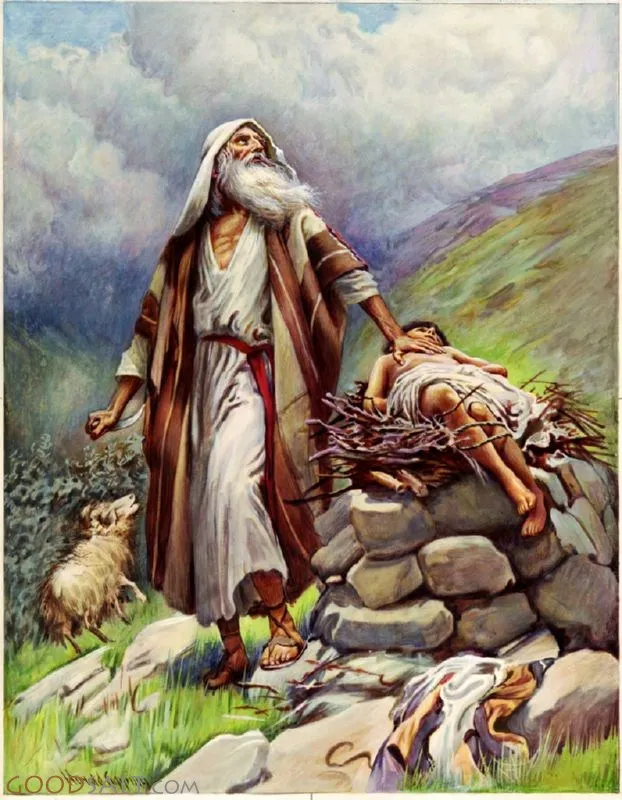
In detail
About 17 tranquil years are passed over in silence. Isaac was now a young man of 20 (see on ch. 21:14 PP 147). It was, as well, 17 years since Abraham had received his last recorded message from God. Suddenly, there came a new revelation, proposing the greatest test that could come to a human being. A vision, which came to Abraham at night was the eighth occasion on which God spoke to Abraham. Previous experiences had taught Abraham to recognize God's voice immediately, and he was ready to answer. This brief introductory conversation consists of but two words in Hebrew, and in this respect differs from similar occasions in the past.
God tells Abraham to take his only son to the land of Moriah and offer him as a sacrifice. If these words were spoken slowly, as is probable, Abraham must have felt, in sequence, pride, fear, and awe. Repetition was calculated by God to arouse parental affection and to prepare Abraham for the severe test soon to follow. In calling Isaac, Abraham's "only son," God implied that he alone was considered a legitimate heir to the promise. The sacrifice of human beings, particularly of infants, was common in ancient times. Both the Bible and archeology affirm that the Canaanites practiced such rites.
The idea of sacrificing one's first—born to the deity was therefore nothing strange to Abraham. While God explicitly prohibited such sacrifices (Lev. 18:21), it is not certain that Abraham was clear as to this. Indeed, only on the assumption that he did not understand this divine ban can we explain his failure to protest God's command to offer up his son.
In the supreme test of a long, eventful life Abraham obeyed without raising a single question, without offering a single objection, and without seeking human counsel. Where principle is involved, the mature Christian asks no more than a clear perception of duty. His cooperation springs from a heart overflowing with love and devotion. He lives as in the very presence of God, with no human considerations to dim his apprehension of truth and duty. Yet, upon this occasion, what a struggle must have taken place in the heart of the "friend of God," not as to whether he would obey, but rather for divine assurance that his senses and reason were not deceiving him.
Father and son began the ascent in silence, Abraham in meditation and prayer, and Isaac pondering over his father's unwonted reticence as to the nature and purpose of their journey. Alone with his father, solitude invited Isaac to give expression to his bewilderment over the absence of a lamb. Reaching the spot where in later centuries the Temple stood, father and son reared an altar. Salem, the city of Melchizedek, was scarcely more than a stone's throw to the south. But a little farther, to the northwest, was the hill later known as Golgotha.
When all was complete, and nothing remained save the placing of the sacrifice upon the altar, Abraham tremblingly told Isaac all that God had revealed to him, and probably added to that his own faith in Isaac's restoration. It is difficult to imagine the mingled feelings that must have surged through Isaac's breast—amazement, terror, submission, and finally faith and trust. If such were the will of God, he would count it an honor to yield his life in sacrifice. A young man of 20, he might easily have resisted instead, he encouraged his father in the final moments preceding the climax.
That Isaac understood and shared his father's faith was a noble tribute to the careful training he had received through childhood and youth. Isaac became thus a fitting type of the Son of God, who yielded to the will of His Father (Matt. 26:39). In each case the father gave up his only son. Having laid the bound victim upon the wood, Abraham was ready for the last act, the slaying of his son and setting fire to the pile of wood. As a type of the perfect Lamb of God, Isaac offered no resistance and voiced no complaint (see Isa. 53:7).
But the angel of the Lord stopped Abraham. The patriarch had amply demonstrated his faith and obedience and had fully satisfied the requirements of his God. Jehovah did not desire the death of Isaac in fact, He was not interested in any sacrificial offerings as such. But He has ever desired the willing obedience of His servants (1 Sam. 15:22 Hosea 6:6). So far as the will and purpose of father and son could go, the sacrifice was complete. God accepted the devotion of their hearts as a gift far more acceptable in His sight, and took the will for the deed (Heb. 11:17).
The heavenly voice also testifies to God's rejection of human sacrifices (see Deut. 12:31 2 Kings 17:17 2 Chron. 28:3 Jer. 19:5 Eze. 16:20, 21). The assertions of Bible critics to the effect that the Hebrews, as a part of their regular order of service, practiced the rite of human sacrifice, so common among the Canaanites and other peoples of antiquity, is without foundation.
Bible passages
- Genesis 22:1-19
1 And it came to pass after these things, that God did tempt Abraham, and said unto him, Abraham: and he said, Behold, here I am. 2 And he said, Take now thy son, thine only son Isaac, whom thou lovest, and get thee into the land of Moriah; and offer him there for a burnt offering upon one of the mountains which I will tell thee of. 3 And Abraham rose up early in the morning, and saddled his ass, and took two of his young men with him, and Isaac his son, and clave the wood for the burnt offering, and rose up, and went unto the place of which God had told him. …
Text of the King James Version.
Images