
The place
Sinai, also known as Mount Sinai, Horeb, or Mount Horeb, is one of the most significant locations in the Bible. It is the mountain where God revealed Himself to Moses and gave him the Ten Commandments, as well as other laws and instructions for the Israelites.
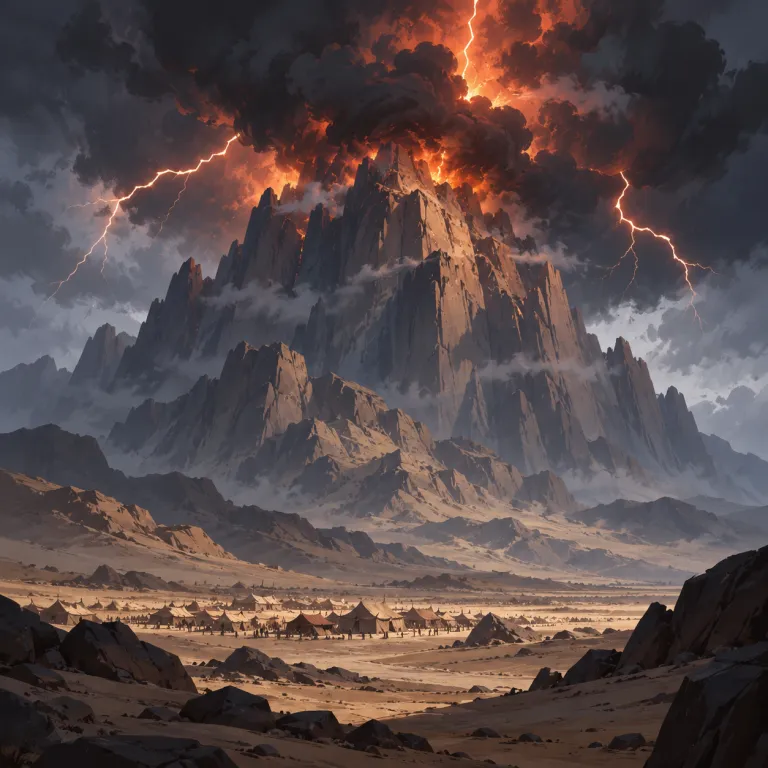
After the Exodus from Egypt, the Israelites camped at the base of Mount Sinai for about a year (Exod. 19:1-2). During this time, God called Moses to the top of the mountain and spoke to him, giving him the Ten Commandments and other laws (Exod. 19-31). The mountain was filled with smoke, fire, and thunder, symbolizing the awesome presence of God (Exod. 19:16-19).
Moses spent forty days and forty nights on the mountain, receiving instructions from God and writing down the laws (Exod. 24:18; 34:28). He also received the two stone tablets inscribed with the Ten Commandments (Exod. 31:18; 34:1, 4, 28-29).
The location of Mount Sinai is not specified in the Bible, but tradition has identified it with Jebel Musa (Mountain of Moses) in the southern part of the Sinai Peninsula. However, some scholars have proposed alternative locations, such as Jebel al-Lawz in Saudi Arabia, based on various geographical and archaeological considerations.
Throughout the Bible, Sinai is mentioned as a symbol of God's revelation, covenant, and law (Deut. 33:2; Judg. 5:5; Ps. 68:8, 17; Neh. 9:13; Mal. 4:4). In the New Testament, Paul uses Sinai as an allegory for the old covenant, in contrast to the new covenant represented by the heavenly Jerusalem (Gal. 4:24-25).
The events at Sinai, including the giving of the Ten Commandments and the establishment of the Mosaic covenant, were pivotal moments in the history of Israel and laid the foundation for their identity as God's chosen people.
Where this place lies
Where the Bible names it
31 chapters, 43 verses