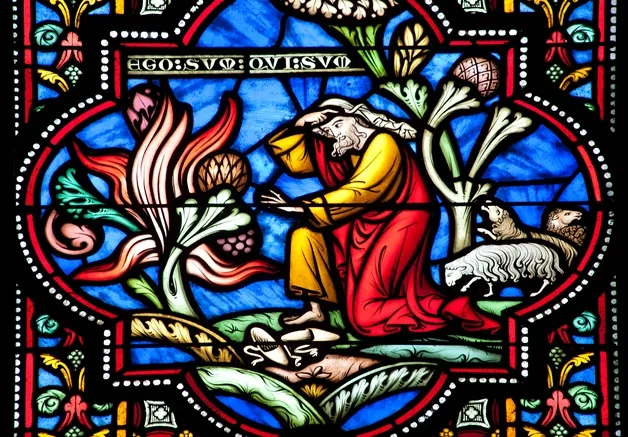
Moses' Prophetic Call
- Dates
- 1446 BC
While tending his father—in—law's sheep near Mt. Horeb, Moses sees a burning bush. God speaks to Moses through the burning bush and calls him to lead the children of Israel out of Egypt. Moses feels inadequate. God answers all 5 of Moses' objections.

In detail
The burning bush was an appropriate visible representation of the message God there imparted to Moses. In contrast to the more noble and lofty trees (Judges 9:15), the thorn bush may be compared to the people of Israel in their humiliation, despised by the world. The fire, burning but not consuming the bush, may be thought of as representing the refining affliction of slavery. But the bush was not consumed and in the chastening flame the Lord does not give His people over unto death (Ps. 118:18).
As Moses approached the bush he did not expect to receive a vision, nor was he yet conscious of the presence of God. Therefore, when he drew near to examine "this great sight" (v. 3), he was admonished to remain at a safe distance from the bush. The place where Moses stood was holy, not because it was an old sanctuary or sacred spot previously unknown as such to him, as some commentators have thought, but because of the presence of God. The glory of the holy God no sinful man can bear hence it was only natural for Moses to hide his face. Elijah later did likewise at the same place (1 Kings 19:13), and even the holy angels before God's throne in heaven do so (Isa. 6:2).
God called Moses to bring the Israelites out of Egypt into a land flowing with milk and honey. A great change had come over Moses. Forty years earlier he had volunteered as a deliverer. He had gone to his brethren and slain one of their oppressors, expecting that they would understand "that God by his hand would deliver them" (Acts 7:25). However, at that time he was not qualified for the position of leadership to which he aspired, nor were the children of Israel ready for deliverance. The 40 years in Midian had taught him humility and filled him with utter distrust of self.
The adopted prince of Egypt's royal house had become a shepherd, following a pursuit despised by the Egyptians (Gen. 46:34), and felt so uncertain of himself as to fear Pharaoh. What influence could he, a despised shepherd from the eastern desert, expect to have with the mighty king of the most powerful nation on earth? Furthermore, what influence would he have with his own people? They had rejected him when he was a mighty man would they accept his leadership as a returned fugitive? Thoughts like these may have flashed through Moses' mind when the call to return to Egypt and deliver his people came to him. His reluctance to accept the call, his distrust of himself and of his people, can be easily understood.
God did not refute Moses' arguments, but assured him of divine companionship and assistance. No human skill, no earthly power or ingenuity alone, can accomplish what is possible in cooperation with God. No greater promise can come to a leader of God's people than that given to Moses at the time he was called.
Bible passages
- Exodus 3:1-22
1 Now Moses kept the flock of Jethro his father in law, the priest of Midian: and he led the flock to the backside of the desert, and came to the mountain of God, even to Horeb. 2 And the angel of the Lord appeared unto him in a flame of fire out of the midst of a bush: and he looked, and, behold, the bush burned with fire, and the bush was not consumed. 3 And Moses said, I will now turn aside, and see this great sight, why the bush is not burnt. …
- Exodus 4:1-17
1 And Moses answered and said, But, behold, they will not believe me, nor hearken unto my voice: for they will say, The Lord hath not appeared unto thee. 2 And the Lord said unto him, What is that in thine hand? And he said, A rod. 3 And he said, Cast it on the ground. And he cast it on the ground, and it became a serpent; and Moses fled from before it. …
Text of the King James Version.
Images